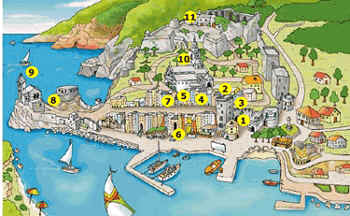
The Castle of Porto Venere stando on a rocky elevation of the round right above the village.
The Castle has a strong structure with closed sloping wallas and vaukts made of local stone.
Due to the tecnological improvement of fortifictions and fire-arms, the architectonic strucuture of the Castle has been modified both outward and in its inside arrangement; nevertheless, it still stands as an outstanding example of Genoa military architecture.
The origin of the early fortified building remains unclear in spite of the attemps of many archaeologists.
The only historical sources, which give them same information about the previous construction are: the “Cartularia” (registers) belonged to Mr. Giovanni di Giona, notary in Porto Venere (1240); the latin verses of Mr. Ursone da Vernazza, notary and poet (1242) together with the “annuali” (chronicles) drew up by the “Caffaro” for the Republic of Genoa.
The position of the previous Castle, the one mentioned in the “Cartularia”, was the same as today because the aim of the building was to play an active role in the defence of the village from any enemy attacks. Although at first sight the construction looks lide a vaste monolith, it is nevertheless composed by two big different blocks surronded by cyclopean masonry: a “low block” with the main entrance with a view over the village, and a “high block” including the remaining structures (1500); in this area, there is a large “hypostyle room” (the name comes from same early temples where a flat roof was supported by culumns) and a second main door at the top of a staircase.
Upon the “hypostyle room”, there is the “Casa del Castellano” (House of the Lord of the Castle) where in 1500s, the Lord of the Castle or Captain of the People lived, who did not depend on the authority of Podestŕ of Porto Venere.
In the same years, a garrison of crossbowmen and arquebusiers was assigned to the building and same rooms should be used as living quartes. Today, they are no more recognisable.
In 1500s, when the utilisation of fire-arms increased, if was necessary to create an esplanade in the “high block” at the same level of che covering of the hypostyle room.
On the north area, there is the remain of the fortress (16th century) with its impassable barrages on two sides, its wide communication trenchs and look-out turrets with loopholes. This area was equipped for the conventional defence made by arquebuses and weapons suitable for repelling the besiegers.
On the contrary, in the “low block” of the fortress the defence was organized by means of guns.
The Castle “in excelso rupis”, described by Ursone di Vernazza, and bound to the history of Colonia Januensis, did not escape the events of Napoleon’s rule. They began when Genoa and its age-old republic were handed over Napoleon in 1797.
During the days of Napoleon’s rule, the Castle was used as a political prison. As a result of it, the “hypostyle room” was spoiled in order to create the cells as the scratchen of the bars can prove it.
The Town Council of Porto Venere in collaboration with the company "Port and Tourist Services of Porto Venere", has been offering to all citizens (italian adn foreign) the possibility to celebrate civil weddings in the Doria Castle.